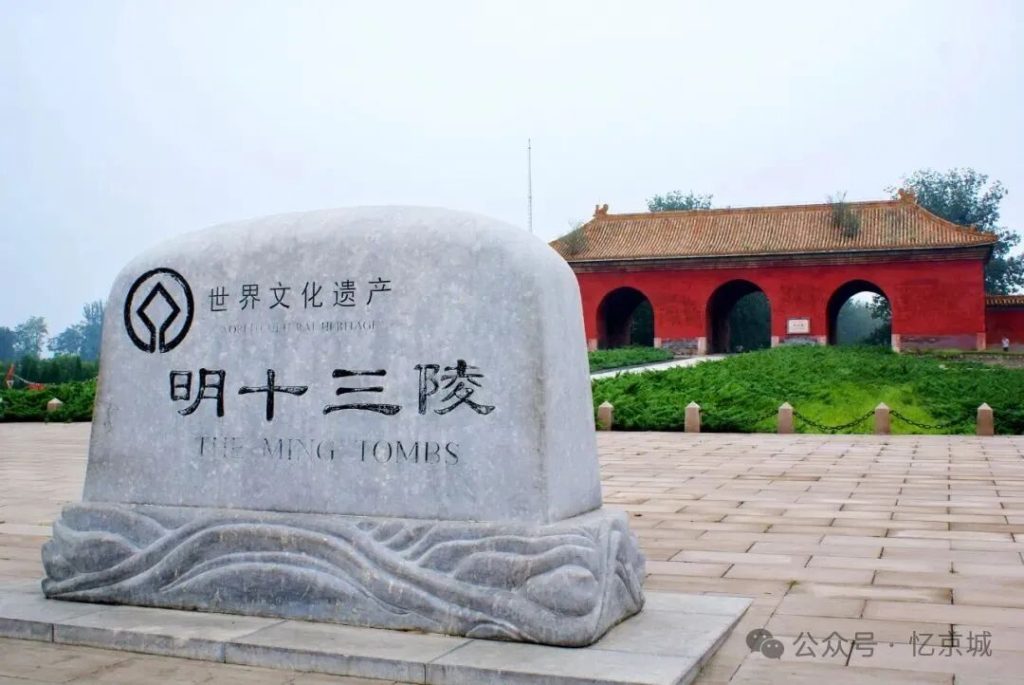
The Ming Tombs is the collective name for the tombs of the thirteen emperors of the Ming Dynasty after the capital was moved to Beijing. They are located at the foot of Tianshou Mountain, north of Changping in Beijing. All thirteen imperial tombs were built along the mountains, scattered across the eastern, western, and northern foothills, forming a grand, majestic, and well-preserved complex of imperial mausoleum architecture.
The Ming Tombs are located in the northwestern suburbs of Beijing, about 10 kilometers north of Changping County (now Changping District) and 42 kilometers from downtown Beijing. They are a nationally protected cultural heritage site and a 5A-level tourist attraction. They have also been inscribed on UNESCO’s World Cultural Heritage List. As one of the world’s most famous historical landmarks, the Ming Tombs attract countless visitors from both China and abroad.
Further Reading:[Beijing Free Travel Guide] Must-Visit Attractions, Accommodation, Food, and Costs

The Ming Tombs are the world’s most well-preserved and the largest imperial burial complex, with the greatest number of emperors buried in one location. The entire mausoleum area covers about 40 square kilometers. To the east, west, and north stand ranges of towering mountains, layer upon layer and magnificent in scale. To the south, Mang Mountain and Huyu Mountain face each other like powerful guardians — symbolizing the “Azure Dragon” and the “White Tiger.” The main ceremonial gate to the mausoleum complex is set between these two mountains. Beyond the gate lies a wide basin through which the Wenyu River winds gently. With rolling green hills, dense forests, and beautiful natural scenery, the imperial tombs are harmoniously embedded within this tranquil landscape.
The Ming Dynasty lasted 277 years, from 1368 when Zhu Yuanzhang declared himself emperor in Nanjing, until the fall of the dynasty. In total, there were sixteen emperors. In the seventh year of the Yongle reign, Emperor Zhu Di personally inspected and selected the Huangtu Mountain area as the burial site, renaming it “Tianshou Mountain.” Construction of the tomb complex began shortly afterward. In May 1409, work began on Changling, the first tomb at Tianshou Mountain. From that time until the Chongzhen Emperor was buried in the Tomb of Concubine Tian, the construction and use of the tomb complex spanned over 200 years, with thirteen emperors eventually buried there. For this reason, it came to be known collectively as the “Ming Tombs.”
Ming Dynasty Thirteen Tombs Scenic Area
Changling
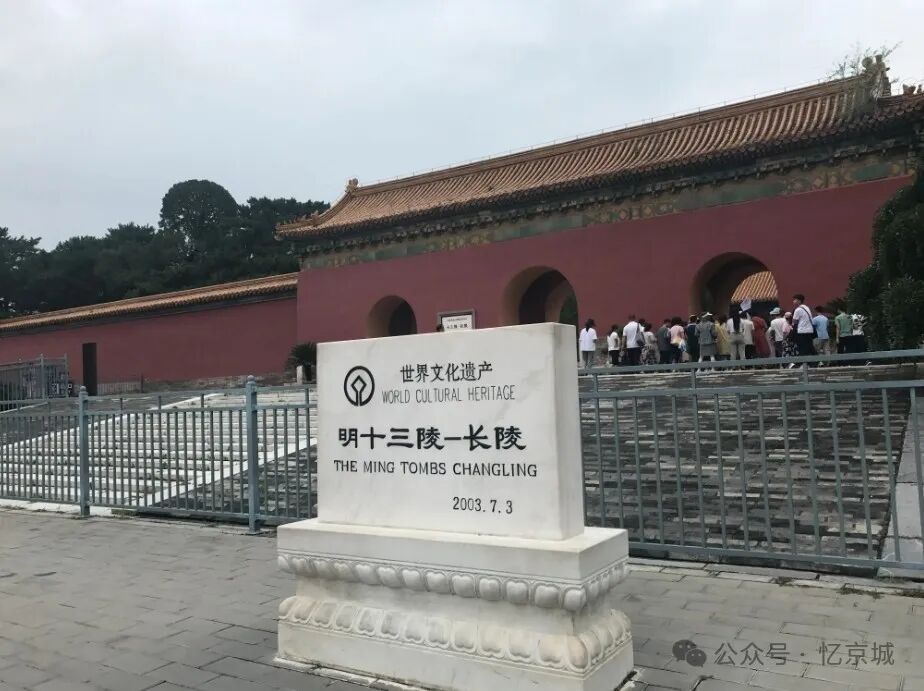
In front of the Ming Tombs area stands a tall stone memorial archway (paifang). This stone archway has five openings, six pillars, and eleven tiers, measuring 28.86 meters wide and 14 meters high. It is built in the style of traditional wooden architecture. On the six supporting pillars, eight pairs of lions playing with embroidered balls are carved in relief, along with sixteen dragons, all vivid and lifelike. About 500 meters north of the stone archway is the main ceremonial gate of the Ming Tombs. This grand gate faces south and features three arched openings, red walls, yellow glazed tiles, and a single-eaved hip-and-gable roof. It is constructed of brick and stone. On both the east and west sides of the gate are enclosing walls surrounding the various tombs, with a total perimeter of 40 kilometers. Ten gates were built into this wall system, four of which are water gates.
Passing through the ceremonial gate, you enter the Sacred Way (Shen Dao), the main ceremonial pathway shared by all the Ming imperial tombs. It serves as the guiding axis of the mausoleum complex. The Sacred Way begins at the stone archway in the south and extends northward to Changling, a total length of 7,000 meters. Along the route are stone statues, the Lingxing Gate, the Five-Arch Bridge, and the Seven-Arch Bridge. From the Seven-Arch Bridge, the Sacred Way branches off toward the individual tombs. On both sides of the Sacred Way stand rows of cypress trees. Passing through these trees, you will come upon a pavilion with a double-eaved hip-and-gable roof. Inside stands a huge stone stele mounted on the back of a stone tortoise, with a total height of 6.5 meters. How such a massive stele was erected onto the tortoise’s back in ancient times is not clearly recorded in historical documents, but there is a traditional explanation called the “buried-tortoise method.” According to this, earth was piled up over the tortoise carving, the stele was then dragged up the slope and set into place, and afterward the earth was removed, revealing the complete tortoise-borne stele. The inscriptions on all four sides of the stele are of great historical value. The south face bears the inscription “The Sacred Virtues and Achievements of the Great Ming Changling,” over three thousand characters long and written in the hand of Emperor Renzong, praising the deeds of Emperor Yongle. The back (north) face contains Emperor Qianlong’s poem “Thirty Verses Mourning the Ming Tombs,” a travel record written in a highly distinctive style. The east side bears inscriptions carved in the 52nd year of Qianlong’s reign, recording the expenses for repairing the Ming Tombs. The west side contains an imperial essay by Emperor Renzong of the Qing Dynasty, discussing the reasons for the fall of the Ming. The original text of the Sacred Virtue Stele was composed in the first year of the Hongxi reign and the stele itself was erected in the tenth year of the Xuande reign.
At each corner of the stele pavilion stands a white marble ornamental column (huabiao), intricately carved with cloud and dragon designs. Lotus motifs appear both above and below, with a cloud-shaped panel near the top, and crowning each column is a mythical beast known as a “heaven-watching hou.” Not far from the pavilion, along both sides of the Sacred Way, stand eighteen pairs of stone figures and animals. The first pair is two decorated stone pillars carved entirely with “Three Blessings Cloud” patterns. There are six types of stone animals in total — lions, xiezhi (mythical beasts), elephants, camels, qilin, and horses — forming twelve pairs, six standing and six recumbent. Behind them stand four military officials, four civil officials, and four meritorious officials. Altogether, thirty-six stone statues line the 800-meter stretch of the Sacred Way. They were placed there in the tenth year of the Xuande reign (1435) and have stood for nearly 600 years. Beyond the stone figures is the Lingxing Gate, also called the Dragon-and-Phoenix Gate. The name Lingxing Gate signifies the “Gate of Heaven,” and so it is decorated with motifs such as flaming pearls and cloud panels; entering this gate symbolically means entering the celestial realm. Continuing northward, you can look ahead toward Tianshou Mountain, where a vast architectural complex comes into view — the grand Changling Tomb, the first and principal tomb of the Ming Tombs complex.
Changling, the Tomb of Emperor Yongle, is the ancestral mausoleum among the Ming Tombs and is the burial site of Emperor Yongle (Zhu Di) and his empress. Construction of Changling began in the seventh year of the Yongle reign (1409) and the tomb covers an area of about 10 hectares. Its overall layout follows the traditional style of a square front and circular rear. Along the central axis stand the main structures: the Ceremonial Gate, the Ling’en Gate, the Inner Red Gate, the Dragon-and-Phoenix Gate, and the Ming Tower. Auxiliary buildings are symmetrically arranged on both sides, forming three successive courtyards.
From the Ceremonial Gate to the Ling’en Gate lies the first courtyard. On the east side stands a stele pavilion built in the fifteenth year of the Jiajing reign, with a tortoise-shaped base and dragon head. The Ling’en Gate faces south and has a single-eaved hip-and-gable roof. It is five bays wide, measuring 31.44 meters across and 14.37 meters deep, and its form is similar to the Taihe Gate in the Forbidden City. Passing through the Ling’en Gate, you reach the second courtyard and the Ling’en Hall. This hall has a double-eaved hipped roof, nine bays across, and is 66.75 meters wide; it is five bays deep, measuring 29.31 meters from front to back. The hall stands on a three-tiered stone platform 3.31 meters high, surrounded by white marble balustrades and ornamental pillars. Inside, sixty massive nanmu pillars support the roof structure. The four central pillars are the largest — two people joining hands cannot encircle them — each with a diameter of 1.17 meters. The remaining pillars measure 1.07 meters in diameter, and all rise to a height of 14 meters, making them exceptionally rare examples of precious timber architecture.
A rear doorway in the north wall of the Ling’en Hall leads directly to the Inner Red Gate, and further north is the Dragon-and-Phoenix Gate. From the Inner Red Gate and Dragon-and-Phoenix Gate to the stone offering table before the Ming Tower lies the third courtyard. Atop the Ming Tower stands a stone stele set on a dragon-headed pedestal, carved from pale red stone and inscribed with the words “Mausoleum of the Great Ming Taizong Wen Emperor.” Behind the Ming Tower stretches the circular earth mound known as the Precious City, with a circumference of more than 1,000 meters. At its center is the Precious Dome, beneath which lies the underground palace. In the second month of the eleventh year of the Yongle reign, Empress Xu was buried here. In the twenty-second year of the Yongle reign, after Emperor Yongle’s death, he was interred here as well, and the two were laid to rest together in Changling.
Xianling
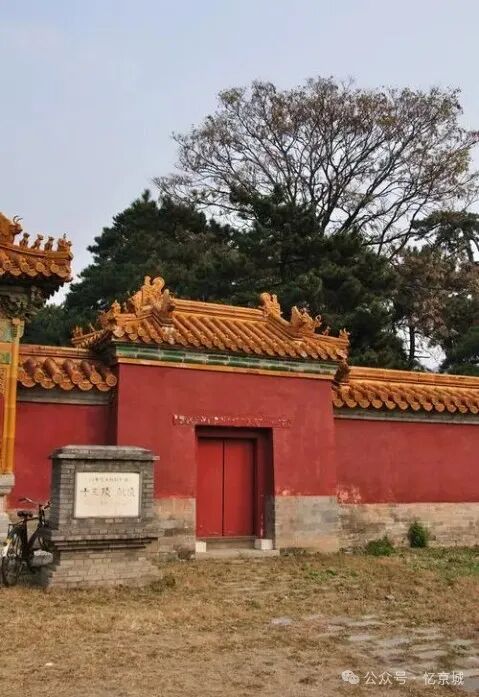
Xianling Mausoleum of Emperor Renzong of Ming. Xianling, one of the Thirteen Tombs of the Ming Dynasty, lies beside Huangshan Temple, 500 meters west of Changling. It houses the remains of Zhu Gaochi, the eldest son of the Yongle Emperor and Emperor Renzong of Ming. Zhu Gaochi ascended the throne in the seventh month of the 22nd year of the Yongle era (1414) and passed away in the fifth month of the following year, at the age of 48. Construction of Xianling began in July, and Emperor Renzong was interred in September. Empress Zhang, who passed away in October of the seventh year of the Zhengtong era, was buried alongside him in Xianling. The tomb's construction was rushed, resulting in a significantly simpler design compared to Changling. Only the ruined Ming Tower, the tomb mound's protective wall, the rear three gates, and sections of the surrounding wall remain today.
Jingling

Jingling Mausoleum of Emperor Xuanzong of Ming. Located 1,000 meters east of Changling Mausoleum beneath Mount Hei, Jingling houses the remains of Zhu Zhanji, eldest son of Emperor Renzong. Known by his reign title Xuande and temple name Xuanzong, he passed away on the third day of the first lunar month in the tenth year of Xuande's reign and was interred at Jingling in the second lunar month. In the ninth month of the sixth year of Tianshun, Empress Sun passed away and was buried alongside him at Jingling. Following the late emperor's will, Emperor Xuanzong personally devised the construction plan for Xianling, conducting the funeral with simplicity and building the tomb modestly. Jingshan was likewise constructed with restraint. According to Illustrations of Imperial Tombs, “Among the tombs at Tianshou, Xianling is the most unadorned, and Jingshan the smallest. Within Tianshou's prime location, only Xianling and Jingshan differ from the naturally formed grandeur of Changling.” " The above-ground structures of Jingling largely mirrored those of Xianling, differing only in Ling'en Hall's double-eaved roof and the tomb mound's elongated oval shape. Only remnants of the surrounding walls, Minglou Pavilion, and tomb mound survive today. When Emperor Xuanzong was interred, ten consorts were buried with him as human sacrifices. Beginning with the founding emperor, every Ming ruler employed human sacrifice in burial rites: Emperor Hongwu (Zhu Yuanzhang) buried 46 consorts; Emperor Yongle (Zhu Di) buried 16 consorts; Emperor Renzong buried 5; and Emperor Xuanzong buried 10.
Yuling

Yuling, the tomb of Emperor Yingzong of the Ming Dynasty. Located 2,000 meters northwest of Changling at the foot of Shimen Mountain, Yuling houses the remains of Zhu Qizhen, the eldest son of Emperor Xuanzong. Zhu Qizhen, whose reign title was Zhengtong (later changed to Tianshun) and temple name Yingzong, ascended the throne at the age of nine. He passed away on the 17th day of the first month in the eighth year of Tianshun and was interred in the fifth month of the first year of Chenghua. His first wife, Empress Qian, died in the sixth month of the fourth year of Chenghua and was buried alongside him in Yuling. Empress Zhou (birth mother of Emperor Xianzong) passed away in the third month of the seventeenth year of the Hongzhi era and was buried alongside him within Yuling. This tomb thus holds one emperor and two empresses. As Emperor Yingzong drew his last breath, he issued a posthumous edict forbidding human sacrifice burials. From that point onward, the practice of human sacrifice was finally abolished in the Ming Dynasty. The above-ground structures of Yuling are essentially identical to those of Jingling, with the sole exception that Ling'en Hall lacks a rear door. The first three imperial tombs each contained one emperor and one empress; Yuling marked the beginning of a pattern of one emperor and two empresses.
Maoling

Mausoleum of Emperor Xianzong at Maoling. Located approximately 3,000 meters northwest of Changling beneath Mount Bao, Maoling houses the remains of Zhu Jianshen, eldest son of Emperor Yingzong, who reigned under the era name Chenghua and posthumous temple name Xianzong. Emperor Xianzong passed away in the eighth month of the 23rd year of the Chenghua era and was interred in the tenth month. His consort, Empress Wang, died in the second month of the 13th year of the Zhengde era and was buried alongside him within Maoling. Empress Ji (birth mother of Emperor Xiaozong) passed away in the 11th year of the Chenghua era and was initially buried at Jinshan. After Emperor Xiaozong ascended the throne, her remains were relocated to Maoling. Consort Shao (grandmother of Emperor Shizong), who died in the 11th month of the 1st year of the Jiajing era, was moved to Maoling in the 15th year of Jiajing. Maoling shares a similar layout with Yuling but is slightly larger in scale. It houses one emperor and three empresses, setting a precedent for joint burial.
Tailing

Tailing Mausoleum of Emperor Xiaozong of the Ming Dynasty. Located approximately 3,500 meters northwest of Changling Mausoleum beneath Mount Bijia, it houses the remains of Zhu Youtang, the third son of Emperor Xianzong (his eldest and second sons died young). His reign title was Hongzhi, and his temple name was Xiaozong. He passed away on the seventh day of the fifth month in the eighteenth year of the Hongzhi era. Construction of the mausoleum began in the sixth month, and he was interred in the tenth month. Empress Zhang, consort of Emperor Xiaozong, passed away in the eighth month of the twenty-first year of the Jiajing reign (1542) and was interred alongside him within Tai Ling. Throughout his life, Emperor Xiaozong devoted himself to Taoism, seeking immortality, yet he lived only to the age of 36. The above-ground structures of Tai Ling mirror those of Mao Ling. According to the Veritable Records of Emperor Wuzong, “The tomb of the late emperor was constructed on Mount Tianshou, named Tai Ling. Ten thousand imperial troops labored on the project, completing it within five months.”
Kang Ling
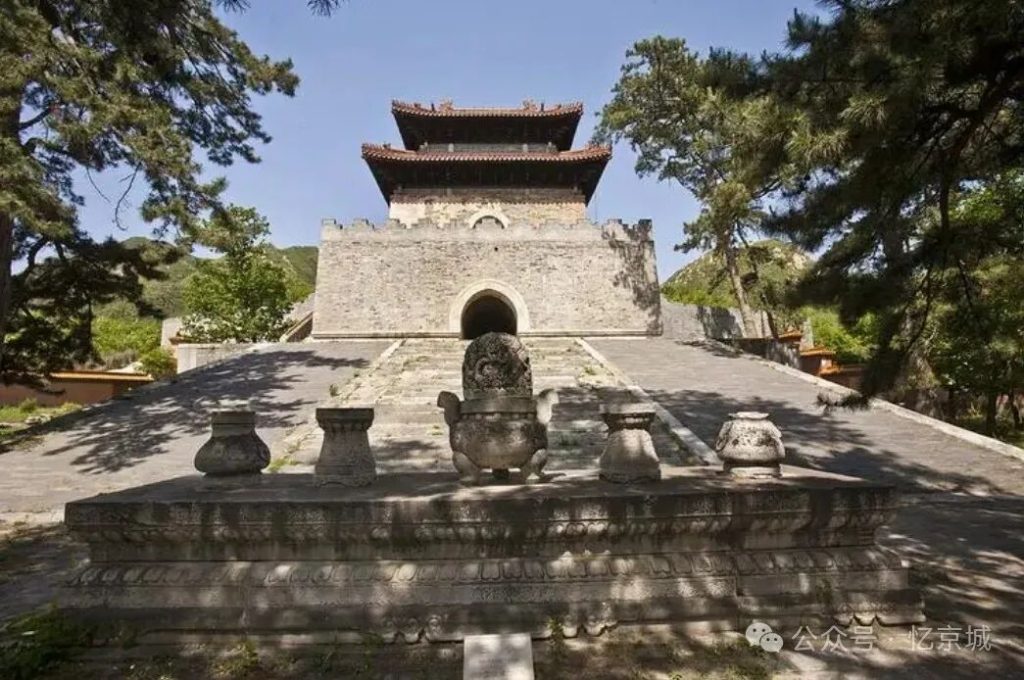
Kangling, the tomb of Emperor Wuzong of the Ming Dynasty. Located approximately 5,000 meters southwest of Changling at the foot of Jinling Mountain, Kangling houses the remains of Zhu Houzhao, the eldest son of Emperor Xiaozong. Known by his reign title Zhengde and temple name Wuzong, he passed away on the 14th day of the third month in the 16th year of the Zhengde era at the age of 31. He was interred at Kangling in the fifth month. Empress Xia, consort of Emperor Jiajing, passed away in the 14th year of his reign and was interred alongside him within Kangling. While the above-ground structures of the first six imperial tombs all face south, Kangling faces east, its layout closely resembling that of Tailing. Today, only the surrounding walls, the tomb platform, and the ruined Ming-style gatehouse remain above ground, with numerous ancient cypress trees still standing within the tomb complex.
Yongling

Yongling Mausoleum of Emperor Shizong of the Ming Dynasty. Located approximately 1,500 meters southeast of Changling Mausoleum at the foot of Yangcuiling Ridge, Yongling houses the remains of Zhu Houchong, cousin of Emperor Wuzong. Known by his reign title Jiajing and temple name Shizong, he passed away on the 24th day of the 12th month in the 45th year of the Jiajing era (1566) and was interred at Yongling in the 1st month of the 1st year of the Longqing era (1567). Empress Chen passed away in the tenth month of the seventh year of Jiajing's reign. She was initially interred at A'er Yu and later relocated to Yongling in the first year of Longqing. Consort Du (birth mother of Emperor Muzong) died in the thirty-third year of Jiajing. She was first buried at Jinshan and moved to Yongling in the forty-third year of Wanli. Emperor Shizong began constructing his mausoleum at age thirty. Yongling's scale surpassed all tombs built after Xianling and even featured an additional outer wall beyond Changling's perimeter. Changling's Ling'en Hall had two more chambers than Yongling's, yet it lacked Yongling's refinement. Yongling featured a stele pavilion, outer perimeter wall, tomb gate, Ling'en Gate, Ling'en Hall, Dragon-Phoenix Gate, stone altar, and the magnificent Ming Tower. The Ming Tower contained not a single piece of wood; its lintels, brackets, and all structural elements were entirely stone. The floor is paved with patterned stone, smooth as grease and hard as steel. Within the tower stands a tombstone inscribed with “The Mausoleum of Emperor Shizong, the Austere Emperor of the Great Ming.” Behind the tower lies the treasure city, its crenellated walls constructed from polished mottled stone, exceptionally sturdy and exquisite. The surviving Ming Tower, treasure city, and engraved stones between the steps still reveal the original grandeur of Yongling. Construction of Yongling began in the 15th year of the Jiajing reign and took twelve years to complete.
Zhaoling
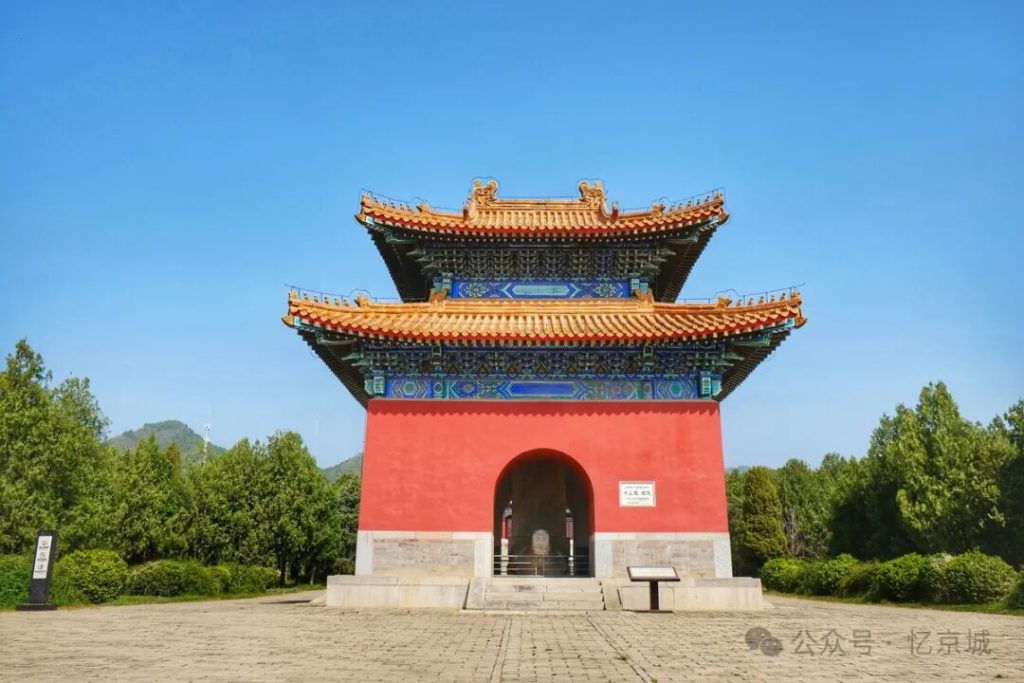
Zhaoling Mausoleum of Emperor Muzong of the Ming Dynasty. Located approximately 2,500 meters southwest of Changling Mausoleum at the foot of Dayu Mountain, Zhaoling houses the remains of Zhu Zaihou, the third son of Emperor Shizong. He reigned under the era name Longqing and was posthumously honored as Emperor Muzong. He passed away in the fifth month of the sixth year of the Longqing era (1572), at the age of 36, and was interred at Zhaoling on the 19th day of the ninth month. Empress Li, who passed away in the 37th year of the Jiajing reign, was initially buried at Jinshan. After Emperor Muzong ascended the throne, her remains were relocated to Zhaoling. Empress Chen (the second consort of Prince Yu) died in the 24th year of the Wanli reign and was interred within Zhaoling. Empress Li (birth mother of Emperor Shenzong) passed away in the 42nd year of the Wanli reign and was also buried within Zhaoling. The above-ground structures of Zhaoling are largely identical to those of Kangling. The tomb faces east with its back to the west. The uninscribed stele within the stele pavilion is shorter than those at other imperial tombs, and the stone carvings are far less intricate than those at Yongling. The approach path is narrow and steep. The tombstone was split by lightning, and the tomb structures were destroyed by the rebel forces of Li Zicheng.
Dingling

The Dingling Tomb of the Wanli Emperor. Dingling is located at the foot of Dayu Mountain, about 2,000 meters southwest of Changling. It is the burial place of Zhu Yijun, the third son of Emperor Muzong. His reign title was Wanli, and his temple name is Shenzong. He ruled for forty-eight years. He died on the twenty-first day of the seventh month in the forty-eighth year of the Wanli reign at the age of fifty-eight, and in the first year of the Taichang reign, in the tenth month, he was buried in Dingling. Empress Xiaoduan, of the Wang clan (the mother of Emperor Guangzong), died in the thirty-ninth year of the Wanli reign. She was first buried at Dongjing, and in the tenth month of the forty-eighth year of the Wanli reign, she was reinterred in Dingling. Construction of Dingling began in 1584 and was completed in 1590, taking six years. It was built following the model of Yongling, with the same layout and design. The stele is carved with six coiling dragons playing in water, exquisitely detailed and full of life. About fifty paces behind the stele pavilion stands the outer Luo City Gate. According to the Illustrated Records of the Imperial Tombs, “The long walls to the left and right of the outer Luo City are carved with mountains and waters, flowers and plants, dragons, phoenixes, qilin, sea horses, turtles, and snakes, all rendered with striking realism.” Except for the Ming Tower, enclosing walls, and the circular Precious City mound, all of Dingling’s above-ground buildings have been destroyed.
In 1955, the Beijing Municipal Bureau of Culture, the Archaeological Institute of the Chinese Academy of Sciences, and the Beijing Cultural Relics Bureau jointly formed the Changling Excavation Committee. Proceeding with great caution, they decided to excavate Dingling first, beginning in May 1956. After more than a year of careful investigation and research, they finally discovered the entrance to the underground palace at a depth of 27 meters — the “Vajra Wall” gate. The Vajra Wall is 8.8 meters high, with a human-shaped entrance in the center, sealed with twenty-three layers of large bricks. Behind the Vajra Wall lies a tunnel, followed by two massive marble gates, each 3.3 meters high, 1.8 meters wide, and weighing about six tons. The doors are carved with nine vertical and horizontal rows of ornamental door studs and ring-shaped handles. Behind the doors is a huge stone lintel. Above the doorway lies a bronze pivot bar weighing about ten tons, within which the door axle is set, allowing the doors to swing freely. Passing through the stone doors, you enter the underground palace.
The underground palace consists of five large and spacious halls — the front, middle, rear, and two side halls — all connected, with seven stone doors in total. The entire complex covers 1,195 square meters. The floors of the front and middle halls are paved with “golden bricks,” and the structure is entirely of stone. The front hall and the two side halls contained no furnishings. In the middle hall stand three white-marble thrones. In front of each throne is a set of five yellow-glazed altar vessels and a large blue-and-white porcelain jar filled with sesame oil to fuel an eternal lamp. The rear hall is the main part of the underground palace. There are three nested coffins: the emperor’s in the center, with the two empresses’ on either side. Around the coffins were placed twenty-six red-lacquered wooden chests containing over 3,000 burial objects. The ceiling of the underground palace is arched, and the entire structure was constructed of massive stones weighing hundreds of kilograms each. Though more than 400 years have passed, it remains perfectly intact. On the original site of Dingling, the Dingling Museum was established. Among its most remarkable treasures are the Wanli Emperor’s gold-thread crown and the empress’s Nine-Phoenix crown, both masterpieces of exquisite craftsmanship.
Qingling Mausoleum
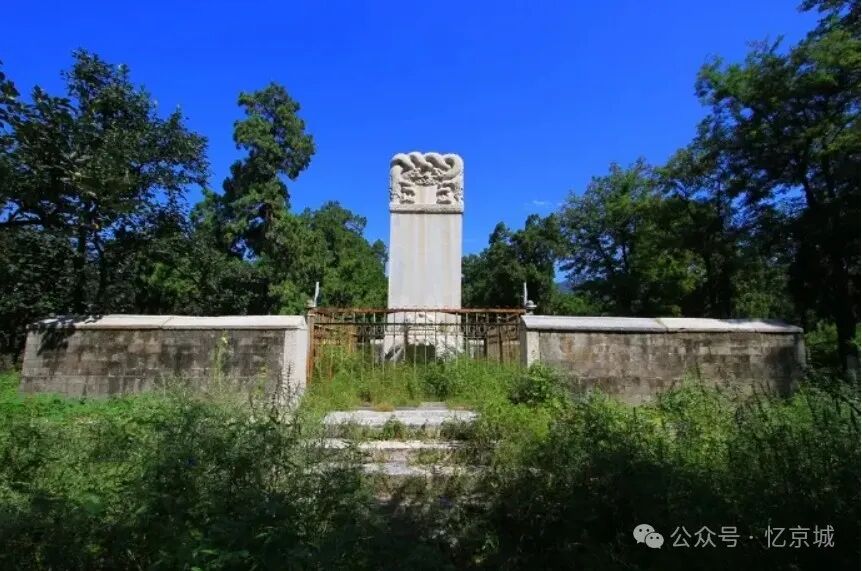
Qingling Mausoleum of Emperor Guangzong. Located approximately 1,500 meters west of Changling Mausoleum at the foot of Huangshan Ridge, Qingling buries Emperor Shenzong's eldest son Zhu Changluo, whose reign title was Taichang and temple name Guangzong. Emperor Guangzong passed away on the first day of the ninth month in the first year of the Taichang era, having reigned for only 29 days. He was interred at Qingling in the ninth month of the first year of the Tianqi era. Empress Guo, who died in the eleventh month of the forty-first year of the Wanli era, was buried alongside him within Qingling. Empress Liu (birth mother of Emperor Sizong) passed away in the twelfth month of the thirty-eighth year of the Wanli era. She was initially buried at Jinshan and later relocated to Qingling after Sizong ascended the throne. Empress Wang passed away in the third month of the forty-seventh year of the Wanli era. She was also moved to Qingling after Emperor Xizong's accession. The above-ground structures at Qingling are essentially identical to those at Xianling. Due to the abundant spring water at the site, a stone-lined water channel encircles the Baocheng (the outer wall of the tomb mound), which remains remarkably well-preserved to this day.
De Ling

De Ling Tomb of Emperor Xizong of the Ming Dynasty. Located approximately 2,500 meters east of Chang Ling, at the foot of the Tanziyu Mountains, it houses the remains of Zhu Youxiao, the eldest son of Emperor Guangzong. His reign title was Tianqi, and his temple name was Xizong. He passed away on the 21st day of the eighth month in the seventh year of the Tianqi era, at the age of 23. He was interred at De Ling in the first year of the Chongzhen era. Empress Zhang, the consort of Emperor Xizong, hanged herself when Li Zicheng's rebel forces entered the capital in the seventeenth year of Chongzhen's reign. She was interred alongside Emperor Xizong in De Ling during the Shunzhi period of the Qing dynasty. De Ling faces westward, with its above-ground structures largely mirroring those of Jing Ling. The Ming-style pavilion rises symmetrically on either side. The tombstone bears the inscription “Tomb of the Wise Emperor Xizong of the Great Ming Dynasty.” Unlike other imperial tombs, the square pedestal features engraved patterns of the “Eight Treasures.”
Si Ling
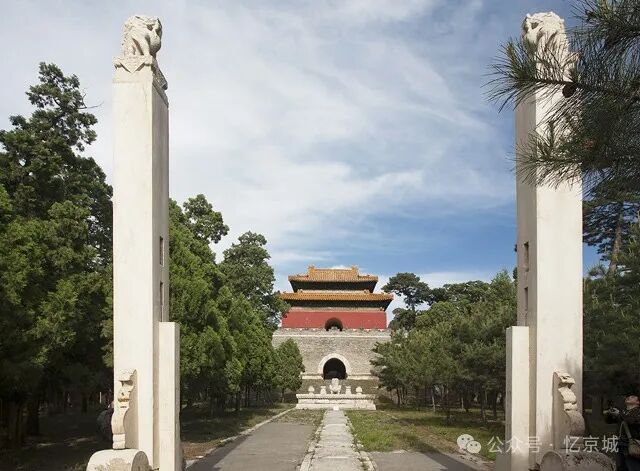
Sizong's Siling Mausoleum. Located approximately 6,000 meters southwest of Changling Mausoleum beneath Jinsheng Mountain, Siling buries the fifth son of Emperor Guangzong (Emperor Xizong had no sons; his will designated his fifth younger brother, Prince Xin Zhu Youjian, to ascend the throne). His reign title was Chongzhen, and his temple name was Sizong. In 1644, when Li Zicheng's rebel forces attacked Beijing, Emperor Chongzhen hanged himself, and Empress Dowager Zhou also took her own life. As Emperor Chongzhen had not constructed a mausoleum during his lifetime, he was interred alongside Consort Tian within her tomb, which was located within the Thirteen Tombs complex. It was not until the sixteenth year of the Shunzhi reign of the Qing dynasty that a three-bay memorial hall and a surrounding wall were finally built for Emperor Chongzhen's tomb.
Ming Thirteen Tombs Scenic Area Details
Important Reminders
1. Advance real-name ticket reservation is required one day prior. Present your ID card for verification at the entrance.
2. Observe all site regulations. Do not touch or climb cultural relics.
3. Prioritize personal safety, especially when visiting underground palaces. Be mindful of slippery surfaces and prevent falls.
4. The entire tour takes approximately 5-6 hours. Wear comfortable shoes and bring water and a sun umbrella.
Recommended Route
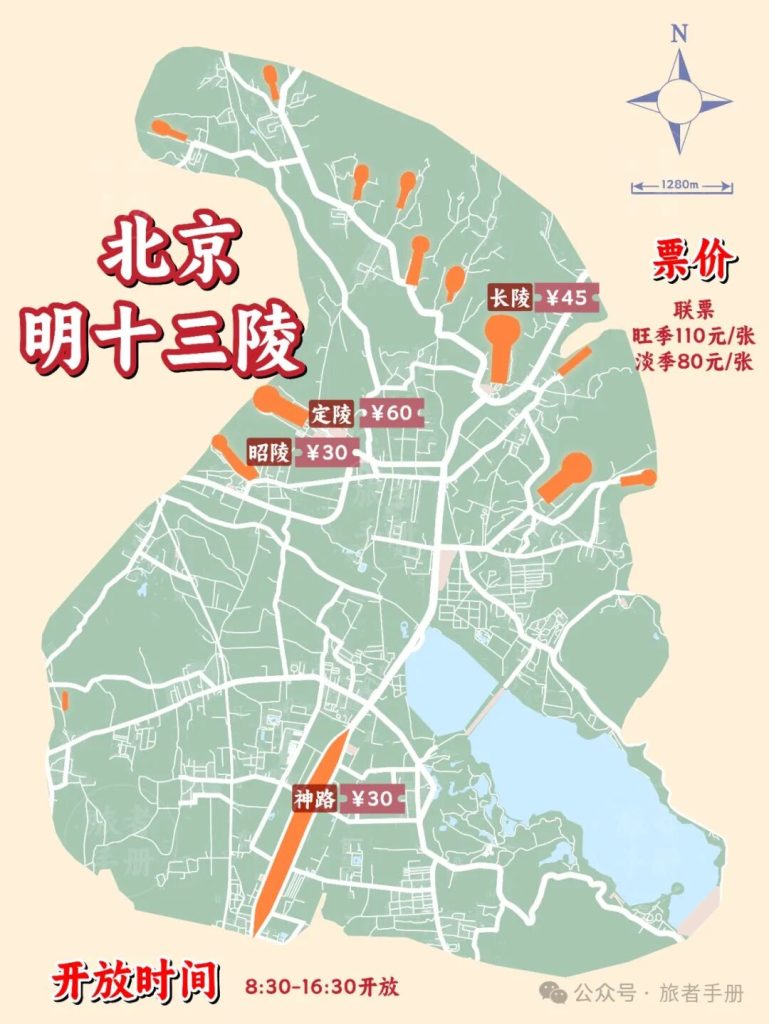
Sacred Way - Changling - Dingling - Zhaoling
Visiting Hours
Sacred Way: 08:30-17:30
Changling: 08:30-17:30
Dingling: 08:30-17:30
Zhaoling: 08:30-17:30
Transportation Guide
Bus: Take Bus 872 from Deshengmen West Station directly to Ming Tombs Scenic Area. Alight at Nanxincun Bus Stop.
Subway: Take the Changping Line to Ming Tombs Scenic Area Station. Exit via Northeast Exit (B). Walk to Jiantou Village West Bus Stop and transfer to Changping Bus 78. Alight at Nanxincun Bus Stop.
By Car: Take Exit 32 on G6 Beijing-Lhasa Expressway → Xiguan Roundabout → Jingyin Road → Changchi Road → Sacred Way.
Ticket Prices
Sacred Way: Adult ticket 30
Changling: Adult ticket 45
Dingling: Adult ticket 60
Zhaoling: Adult ticket 30
Combined Ticket: Adult ticket 132
✅️Ticket Booking: Trip
(Prices listed here are for adult tickets only. For details on discounted tickets, complimentary passes, family tickets, and multi-attraction combo tickets, please visit the “Reservations” section of the Beijing Changping Culture & Tourism Group official account.)